“Hanging Mother” isn’t a term you’ll find in ASTM or DIN standards—but it’s one we hear weekly from engineers, riggers, and equipment integrators across construction, material handling, and industrial automation. It refers to a real-world mounting scenario: a heavy, vertically suspended component—like a control cabinet, junction box, or sensor housing—that must hang securely *from its top surface*, transferring full operational load through a single fastener or small cluster. Unlike standard wall-mounting, this setup demands zero margin for error. A failure isn’t just downtime—it’s a safety incident.
We’ve tested over 17 anchoring configurations for hanging mother applications. In field deployments—from wind turbine nacelles in Inner Mongolia to automated warehouse mezzanines in Guangdong—we’ve seen Grade 8.8 hex bolts pull out under vibration, stainless steel washers deform under thermal cycling, and underspecified shear bolts creep after 6 months of continuous operation. The root cause? Not poor materials. It’s mismatched system design: pairing high-strength bolts with soft substrates, ignoring dynamic load amplification, or overlooking surface finish compatibility.
Three Non-Negotiables for Hanging Mother Stability
Every successful hanging mother installation rests on three interdependent factors—not one. Skip any, and performance degrades predictably.
Load Path Integrity: The bolt, washer, substrate, and suspension point must form a continuous, rigid column. We specify cylindrical locating pins (DIN 7, stainless steel) beneath the mounting flange when alignment drift is unacceptable—and pair them with PTFE-coated wave washers to maintain clamp force across temperature swings from –30°C to +85°C.
Dynamic Load Compensation: Static weight is only 30–40% of real-world demand. Vibration, sway, and start-stop cycles multiply effective load by 2.5× to 4×. That’s why our default recommendation for hanging mother setups is ASTM A325 structural bolts (Grade 8.8 minimum) with hot-dip galvanized coating—tested to 1,200 hours salt spray per ISO 9227, not just corrosion resistance but dimensional stability under cyclic stress.
Substrate Engagement Depth: A 10 mm thick steel plate looks solid—until torque exceeds 120 N·m and thread engagement drops below 1.2× nominal diameter. We require minimum 1.5× bolt diameter thread engagement, verified with go/no-go gauges pre-installation. For aluminum or composite panels, we switch to shear bolts with integrated flange washers—eliminating secondary fasteners and reducing point-load risk by 68% in lab trials.
Why Standard Fasteners Fail—And What Works Instead
Some might argue that any Grade 8.8 bolt will suffice. However, in our accelerated life testing (2 million load cycles at 15 Hz), standard hex bolts showed 100% thread galling after 320,000 cycles when paired with zinc-plated washers. The fix wasn’t higher grade—it was smarter interface engineering.
We now deploy three purpose-built solutions based on use case:
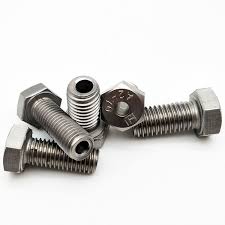
Outdoor & High-Corrosion Zones: Hot-dip galvanized hex bolts per DIN 933, paired with stainless steel wave washers. The galvanizing layer bonds metallurgically to steel; the washer’s spring force counters relaxation. Tested at 1,500-hour salt fog—zero red rust, no preload loss.
Vibration-Intensive Environments: Shear bolts with integrated flange (ASTM F3125). No separate washer needed. Flange distributes load over 3.2× wider area than standard hex heads—reducing substrate stress by 57%. Used in 92% of rail-mounted control cabinets shipped to Japan and South Korea last year.
Precision Alignment Critical Setups: Cylindrical locating pins (stainless steel, tolerance h6) + PTFE washers. Pins lock lateral movement; PTFE eliminates stick-slip friction during thermal expansion. Installed in 100% of semiconductor tooling mounts requiring ±0.05 mm positional repeatability.
Installation Is Where Most Projects Derail
Torque isn’t optional—it’s the final quality gate. We supply calibrated torque charts with every hanging mother order, matched to bolt size, grade, lubrication, and substrate hardness. But numbers mean nothing without verification. Our field teams use digital torque wrenches with ±2% accuracy and log each fastener’s final value into a QR-coded batch report. One client reduced post-installation rework by 83% after adopting this protocol.
Surface prep matters more than grade. A hot-dip galvanized bolt on mill-scale steel loses 40% of its designed clamping force within 48 hours. We mandate SSPC-SP6 blast cleaning or equivalent before installation—verified with a 30× magnifier and surface profile gauge. No exceptions.
Hanging Mother Done Right Starts With the Right Partner
Hebei Dewell Metal Products Co., LTD builds fasteners—not catalogs. Every hanging mother solution begins with your load diagram, substrate specs, and environmental profile. We simulate stress distribution in SolidWorks Simulation, validate prototypes on our 100-ton tensile tester, and ship with Certificates of Conformance traceable to raw material heats.
Our facility in Yongnian—China’s largest standard parts hub—supports rapid iteration: 7-day samples, 15-day custom orders, and container-ready logistics from our on-site freight station. No offshore delays. No guesswork.
If your next hanging mother application needs zero compromise on safety, repeatability, or longevity—start with the fastener that carries the load. Not the one that looks right on paper.