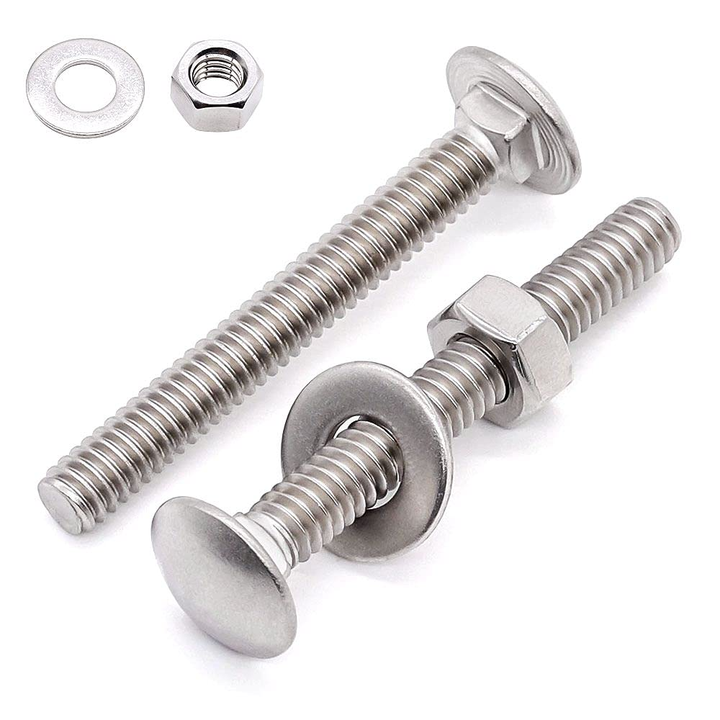
Stainless eye bolts don’t just hold weight—they hold trust. In rigging, marine mooring, overhead crane setups, or architectural suspension systems, one corroded thread or misapplied grade can cascade into downtime, rework, or worse. We’ve seen it: a stainless eye bolt installed in coastal infrastructure failed after 18 months—not from overload, but from chloride-induced crevice corrosion beneath an improperly torqued nut. That’s why material choice, thread engagement, and installation discipline matter more than tensile rating alone.
Why Stainless Eye Bolt Performance Starts Long Before the Lift
Most engineers select stainless eye bolts for corrosion resistance—but not all stainless grades behave the same under mechanical stress and environmental exposure. Grade 304 offers solid general-purpose performance, yet in high-chloride or acidic environments, it risks pitting. Grade 316, with its 2–3% molybdenum content, resists localized attack far more effectively. At Hebei Dewell Metal Products Co., LTD, every stainless eye bolt undergoes batch-certified material verification—no mill certs accepted without traceable heat numbers. We test tensile strength per ASTM F568M, verify thread pitch accuracy to DIN 933 tolerances, and inspect surface finish for micro-cracks that could initiate fatigue failure under cyclic loading.
Real-world performance hinges on three non-negotiables:
- Thread engagement depth: Minimum 1.5× nominal diameter into the anchorage—never less, even with high-strength substrates
- Bending moment control: Eye bolts are rated for straight-line axial loads only; side-loading reduces capacity by up to 75%
- Surface condition integrity: Any scratch, gouge, or heat tint from improper welding degrades passive layer formation in austenitic stainless steels
We routinely advise clients against “upgrading” carbon steel eye bolts with stainless washers or nuts—galvanic coupling accelerates corrosion at the interface. True system reliability demands full-material consistency across bolt, nut, and washer.
The Hidden Cost of Cutting Corners on Finish and Fit
Some buyers assume all stainless eye bolts are interchangeable. They’re not. A bolt machined from bar stock versus one forged from hot-rolled billet carries different grain flow patterns—critical when lifting dynamic or shock-loaded equipment. Forged eye bolts maintain structural continuity through the eye loop; machined versions introduce a potential shear plane at the junction between shank and eye.
At our 10-acre facility in Yongnian, we forge stainless eye bolts using closed-die presses calibrated to ±0.15 mm dimensional tolerance. Each piece passes through in-process hardness testing (Rockwell B scale), thread plug gauging, and dye-penetrant inspection before final passivation in nitric-acid baths per ASTM A967. This isn’t cosmetic—it restores chromium oxide coverage lost during machining, boosting corrosion resistance by 3–5× in salt-spray testing (ASTM B117).
Customers often ask: “Can I use a standard hex-head stainless bolt with an eye welded on?” No. Welding disrupts metallurgy, creates residual stress, and introduces heat-affected zones prone to intergranular corrosion. Certified stainless eye bolts must be forged or cold-headed as a single unit—with no secondary welds compromising load path integrity.
How to Specify Right—Without Overengineering or Underprotecting
Selecting the correct stainless eye bolt means matching four variables: application load, environment, mounting substrate, and regulatory scope. For example:
- Offshore wind turbine nacelle access hatches: Require Grade 316, forged, with UNC threads, minimum proof load 120 kN, and ASME B30.26 compliance
- Food-grade conveyor tensioning points: Demand electropolished Grade 316L, Ra ≤ 0.4 µm surface finish, and FDA-compliant passivation
- Architectural glass curtain wall suspension: Need ASTM A193 Grade B8M Class 2, with certified Charpy impact values at –46°C
We maintain over 400 standardized SKUs—including metric and imperial thread series, reduced-shank variants for weight-sensitive applications, and custom thread lengths up to 300 mm. Lead time stays at 5–10 days for stocked items because we hold raw material inventory on-site and control surface treatment in-house—no outsourcing delays.
When clients send us sketches or CAD models, our R&D team runs finite-element analysis on critical geometries—validating stress concentration at the eye-to-shank transition zone before tooling begins. That’s vertical integration you can measure in cycle time and field failure rates.
Final Word: Strength Is Measured in Service Life, Not Just Breaking Load
A stainless eye bolt’s ultimate value lies in how long it delivers consistent, predictable performance—not its initial tensile number. The best ones disappear into the system: no maintenance, no replacement, no incident reports. They’re specified correctly, installed with calibrated torque tools, inspected annually per OSHA 1926.251, and retired only after documented service life expiration.
If your next project demands corrosion resilience without sacrificing mechanical fidelity, start with verified material, controlled manufacturing, and real-world validation—not just catalog specs. For technical support, dimensional drawings, or sample requests, visit dewellfastener.com. Every stainless eye bolt we ship carries full traceability—from heat lot to final inspection report—and stands behind our commitment: integrity first, quality first, customer first, reputation first.